Talk to any utility interconnection planner in Virginia, Texas, Ohio, Arizona, or the Pacific Northwest and the same phrase surfaces within five minutes: the queue. Utility interconnection queues for greenfield data-center loads have grown to a length that would have been unthinkable a decade ago. Three years is now optimistic. Five to seven is common. In some Loudoun County substations, developers who filed in 2023 are still waiting on studies.
Meanwhile, the load itself continues to accelerate. AI inference is now the single largest driver of net new data-center demand in every major market forecast. The mismatch between where the compute wants to be built and what the grid can actually deliver has become the binding constraint on the entire industry.
The problem is not generation. It is routing.
The instinct is to blame the resource stack: not enough new generation, not enough new transmission, not enough new capacity. That is a real story, but it is not the operational bottleneck for the next thirty-six months. The operational bottleneck is that the grid, in its existing built form, is already delivering an enormous amount of power to buildings that are only using a fraction of what is routed to them. Commercial buildings routinely peak below 60% of their utility-served capacity. Industrial sites with legacy manufacturing footprints are often lower.
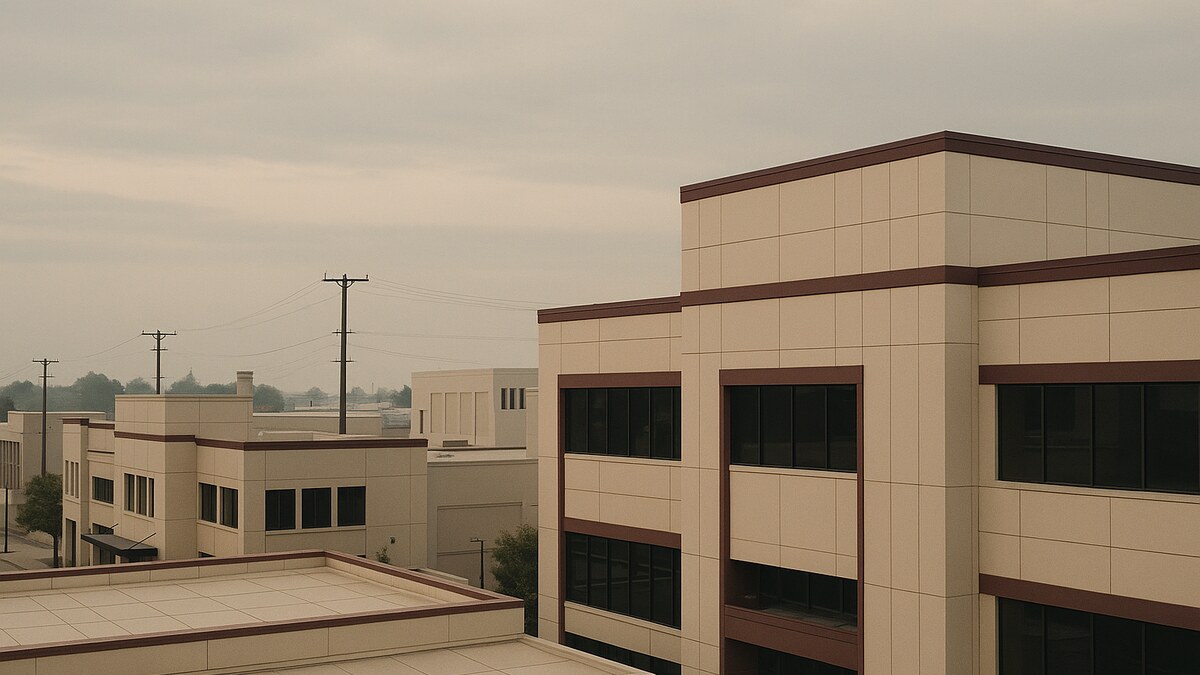
Distributed compute deployed on those existing buildings is drawing from an interconnection that is already energized, already studied, and already sized. No new substation. No new transmission line. No new queue slot.
"The cheapest kilowatt-hour on the grid is the one that is already routed to a building that is not using it. Distributed compute is an arbitrage on stranded interconnection capacity."
What "grid relief" actually looks like
A single hyperscale campus asking for 500 megawatts is a five-year utility conversation. Ten thousand commercial buildings each hosting 50 kilowatts of compute on the roof and drawing from their existing service is a distributed sourcing problem, and one the grid is comparatively well suited to. Local load pockets get exercised closer to their nameplate. Distribution transformers that have been underutilized for a decade start to see a healthier duty cycle. Peak-versus-average ratios flatten across the interconnection footprint, which is exactly what the utility planners have been asking for at every ratemaking hearing for the last ten years.
None of that requires the compute to be less powerful, less concentrated per rack, or less demanding on the cooling side. It requires the physical form factor to fit onto envelopes the grid has already served.
Where the ROSE architecture fits
The ROSE architecture, disclosed in US provisional 64/124,031 (filed May 14, 2026), is built around exactly this deployment pattern. The panels attach to the outer envelope of the host building (roof, façade, walkway, porte-cochère, ground plane, in-floor reinforced areas, interior walls, exterior walls, and the edge of a parking deck). Coolant options include air, water-glycol, refrigerant, single-phase dielectric, and two-phase dielectric, which lets the same architecture serve everything from a low-density edge inference cluster on a school gymnasium roof to a high-density training cluster on a warehouse envelope. Nothing in the architecture requires the host building to interconnect with the utility for new capacity.
The net effect is that a compute deployment strategy which distributes across ten thousand existing buildings is, in the aggregate, using power the grid has already committed to. That is a materially different environmental posture than a five-year greenfield interconnection request, and it does not depend on the tenant, the operator, or the workload changing its underlying compute economics. The bytes get processed. The kilowatt-hours flow through wires that were already energized. The queue gets one fewer entry.
Early access is limited.
ROSE is opening a small cohort for building owners with meaningful flat-roof footprint, energy tenants ready to commit to on-site load, and aligned early-stage investors. If you're one of these, we want to talk.
For information on becoming an early investor or tenant commitment, reach out to us at hello@rosepanel.io.
hello@rosepanel.io