Every hospital IT department is running the same set of workloads for the first time: real-time triage models on emergency-department imaging, ambient documentation tools sitting inside the exam room, and second-opinion inference on radiology reads that once shipped overnight to a distant reader. The value of each of these workloads is proportional to how quickly the result gets back to the clinician. The regulatory posture is proportional to how far the underlying data travels.
Those two forces have started to pull in opposite directions.
The regulatory picture keeps tightening
2026 has been the loudest year on record for U.S. healthcare data enforcement. The HHS Office for Civil Rights has continued to publish record HIPAA settlements, and multiple states (led by Washington's My Health My Data Act, Nevada's health-privacy law, and Connecticut's Personal Data Privacy and Online Monitoring Act) have layered on residency, consent, and transfer restrictions that go beyond the federal floor. Insurers are pricing cyber policies against a hospital's data-egress footprint. General counsel offices are increasingly unwilling to sign off on any architecture that ships identifiable PHI outside the state boundary, let alone to a shared cloud region three time zones away.
"The safest byte of PHI is the byte that never leaves the building. The second safest is the byte that never leaves the campus."
Meanwhile, the clinical demand curve for AI inference is not slowing down. Ambient scribes are getting deployed at the primary-care visit. Imaging pre-reads are being asked for at the point of acquisition, not overnight. Predictive deterioration scores are being wired into the EMR at the bedside. Every one of these workloads wants a millisecond-class round trip and a compliance story that fits on one page.
What "on-premises AI" actually needs
The phrase gets used loosely. In practice, an on-premises inference footprint that a hospital IT team can actually run looks like this:
- Compute density that fits inside an existing building envelope, without a new mechanical room or a new interconnect.
- A cooling architecture that does not require a chiller plant retrofit or a new plumbing loop through the finished ceiling.
- Physical access controls that a healthcare facilities team already knows how to maintain (badge, camera, key).
- A serviceability story that lets biomedical engineering swap a failed cassette without shutting the floor.
- An energy footprint that does not push the building over its interconnect ceiling with the utility.
Traditional rack-based data-center deployments satisfy exactly none of these constraints inside a working hospital. That is why healthcare has been, historically, one of the slowest verticals to move inference on-premises: the building was not designed for it.
How ROSE fits
The ROSE architecture, disclosed in US provisional 64/124,031 (filed May 14, 2026), treats the building's own outer envelope as the compute site. Panels sit on the roof, façade, walkway, porte-cochère, ground plane, in-floor reinforced areas, interior walls, exterior walls, or the edge of a parking deck. The provisional specifies 35 aspects across apparatus, system, method, and vendor-neutral tracks, and covers coolant options explicitly: air, water-glycol, refrigerant, single-phase dielectric, and two-phase dielectric. Coolant interface can be an air-flow channel, a flow-through liquid channel, a cold-plate contact surface, a submersion pool within the panel envelope, or a two-phase evaporator. Nothing in the architecture requires ripping open the finished spaces of a live hospital.
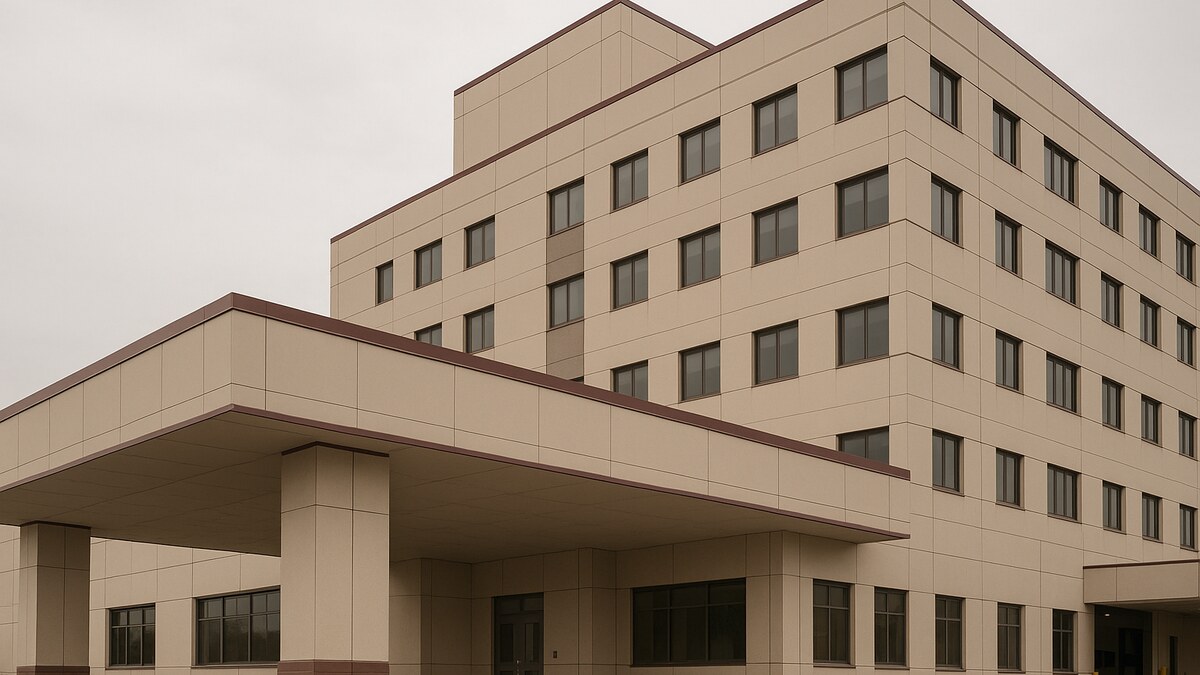
For a health system, that translates into a specific procurement path. A radiology suite can host inference for its own scanners on the roof directly above the reading room. An emergency department can put a compute panel array on the ambulance bay canopy. A cancer center can reserve the porte-cochère roof for the workloads that support its multidisciplinary conference. In each of those cases the data never leaves the campus network, the compute is physically owned and controlled by the health system, and the audit trail is a single facilities work order plus one BAA.
The mechanical work is contained. The compliance work is contained. The clinical latency is measured in the walk from the exam room to the parking deck edge.
Early access is limited.
ROSE is opening a small cohort for building owners with meaningful flat-roof footprint, energy tenants ready to commit to on-site load, and aligned early-stage investors. If you're one of these, we want to talk.
For information on becoming an early investor or tenant commitment, reach out to us at hello@rosepanel.io.
hello@rosepanel.io