Sovereign compute has stopped being a niche procurement conversation. Between the ongoing rollout of the DoD Zero Trust reference architecture, the CMMC 2.0 timelines that touch the entire defense industrial base, and a set of classified-data-locality mandates that have tightened materially since 2024, every defense customer is now asking the same operational question: where does the inference actually run, who physically controls the metal, and can the workload survive a contested electromagnetic environment?
Those constraints have historically pushed defense customers toward one of two options. Option one: build (or lease from a certified vendor) a hardened facility with a dedicated interconnect and a multi-year construction runway. Option two: accept a compromise inference architecture that ships data to a shared certified cloud region and trust that the region's controls are enough. Neither option is well matched to a program office that needs an inference footprint stood up in months, not years, on real estate the government already controls.
The gap the ROSE architecture addresses
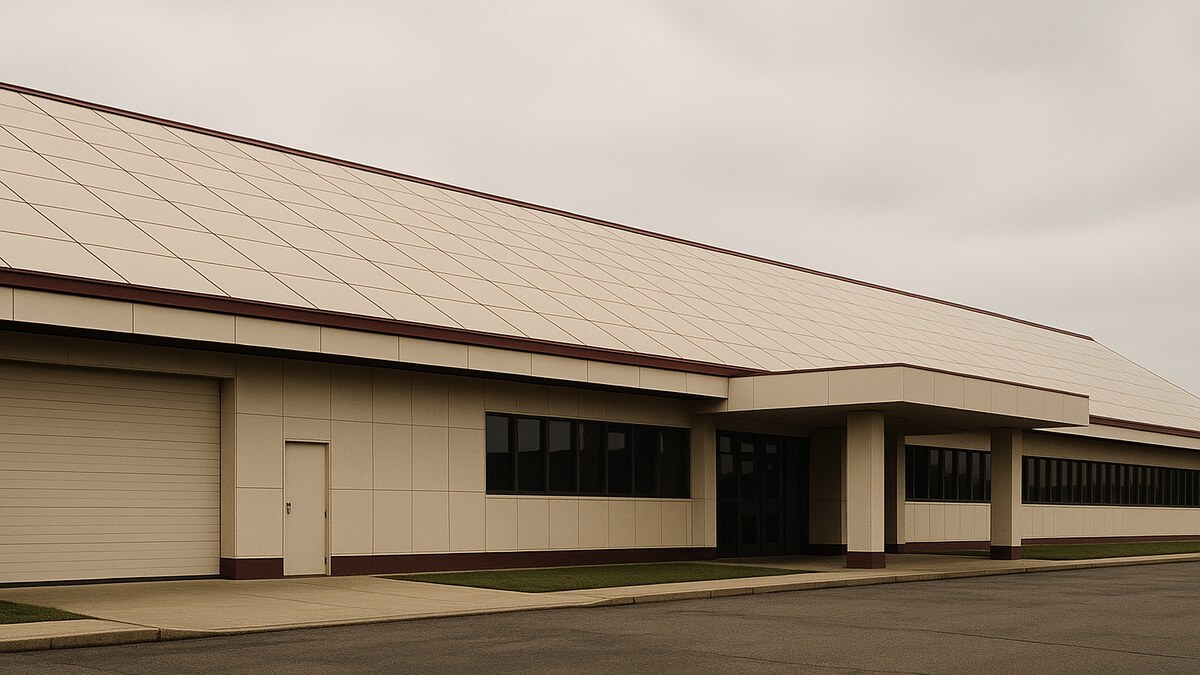
US provisional 64/124,031 (filed May 14, 2026) discloses a Building-Integrated Modular Compute Surface System designed to attach to the outer envelope of an existing structure. For a defense installation, that envelope is often already available: a hangar roof, a maintenance bay canopy, an office roof at a headquarters element, or a purpose-built shelter at a forward-operating site. The panels install without requiring a new mechanical room, without a new chiller plant, and without a new utility interconnection request. The compute is physically on land the government already controls, inside a perimeter the government already secures.
"The unit of sovereign compute is not the data center. It is the building envelope on land the sovereign already controls."
Contested environments and physical resilience
Defense customers rightly ask about resilience under electromagnetic and physical threat conditions. The ROSE architecture is vendor-neutral by design across the cassette interface, which means the specific silicon and specific shielding profile can be selected per site. Coolant options include air, water-glycol, refrigerant, single-phase dielectric, and two-phase dielectric, so the same panel geometry can support a low-density edge inference cluster in a temperate installation and a high-density training cluster in a dedicated shelter. The panel envelope is the boundary of the coolant loop, not a rack in a room, which simplifies both the thermal design and the physical inspection posture.
None of this replaces a purpose-built classified facility for the workloads that require one. It does provide a materially faster and more flexible option for the very large and growing set of defense workloads that need on-premises inference at the edge of an installation, with sovereign physical control, without a new construction program.
Zero Trust and the on-premises inference thesis
The federal Zero Trust reference architecture assumes that identity, device posture, and data classification travel with every request. It also assumes that the underlying infrastructure has enough physical control that the perimeter has meaning. Distributed compute on the building envelope is a natural fit for that assumption: the inference happens on hardware owned by the installation, sitting on a structure inside the fence line, connected to a network the installation controls end to end.
The alternative (shipping every inference request to a shared certified region hundreds of miles away, over a network segment the installation does not fully control) is workable for many workloads, and defense customers will continue to use it. It is not workable for the workloads that combine sensitive classification with real-time latency requirements, and that overlap is growing every quarter as AI-enabled tactical and intelligence workflows come online.
ROSE is engaging with primes and program offices in that overlap. If your program sits inside it, the address at the bottom of this page is the fastest way in.
Early access is limited.
ROSE is opening a small cohort for building owners with meaningful flat-roof footprint, energy tenants ready to commit to on-site load, and aligned early-stage investors. If you're one of these, we want to talk.
For information on becoming an early investor or tenant commitment, reach out to us at hello@rosepanel.io.
hello@rosepanel.io