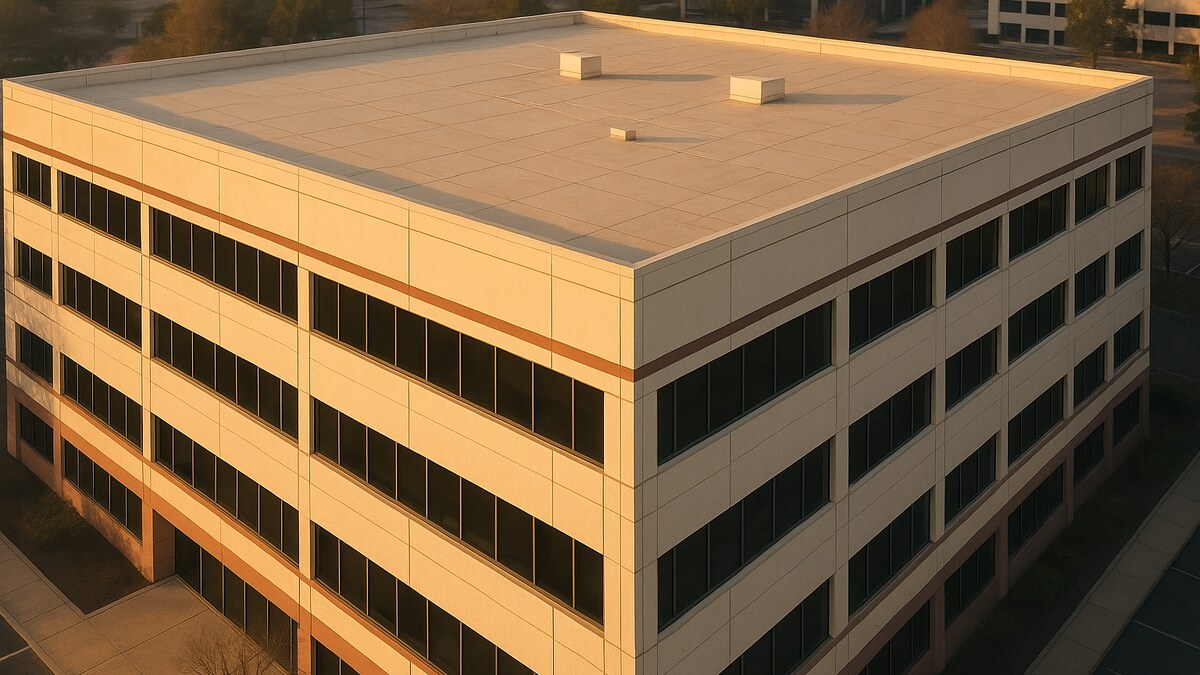
For sixty years, the commercial rooftop has been an income statement footnote. A landlord might collect a modest monthly check from a cell-tower operator, a HVAC vendor, or a rooftop-antenna licensee. The typical square-foot yield on those leases sits somewhere between forty cents and four dollars per year, depending on market and coverage value. Compared to the interior tenancy that the building was actually designed to sell, the rooftop is treated as an afterthought.
Distributed compute changes that math.
What a compute-tenancy contract actually looks like
A compute tenant is not a colocation renter. They are not asking for a hardened building with N+2 cooling, a raised floor, and a dedicated substation. They are asking for something much smaller and much more portable: a defined footprint on the building envelope, a defined power and cooling budget, and a defined service-level and access agreement. In exchange, they place their own compute hardware on the envelope, operate it against their own workloads, and pay the building owner rent that reflects three components:
- Envelope area. The physical square footage of roof, façade, walkway, or parking-deck edge dedicated to the tenant's panels.
- Power passthrough. The utility-supplied power routed to the tenant's footprint, generally billed at cost plus a modest handling fee.
- Access and service. A predictable schedule of hardware refresh, cassette-level swaps, and physical-security escort.
The rate structure that emerges from the first cohort of these contracts is meaningfully higher than any historical rooftop lease. On a per-square-foot basis, a compute tenant is willing to pay ten to one hundred times what a rooftop-antenna licensee pays, because the tenant's revenue-per-square-foot on the underlying workload is itself enormous. AI inference and finance-adjacent workloads regularly clear tens of thousands of dollars in annualized revenue per square foot of compute footprint. The building owner is capturing a slice of that stack.
"The rooftop is not an antenna site. It is a computing site. The comparable is not a cell-tower lease. The comparable is a small colocation cabinet, and it prices accordingly."
A simple TCO framing for a building owner
Consider a 100,000 square foot Class B office building with a 60,000 square foot flat roof. Historically, that roof has generated a rooftop antenna check in the low four figures per year, an HVAC lease for equipment placement, and periodic maintenance access. Total rooftop revenue: single-digit thousands, effectively noise on the P&L.
Under a compute tenancy contract for a meaningful portion of the same roof, the same landlord can underwrite a materially larger recurring line item, plus a share of the panel-level energy passthrough. Even at conservative early-market rates, that is a step function on the roof's contribution to net operating income. The building owner also picks up two second-order benefits: a resilience story for the interior tenants (compute on the roof can be architected to keep the building's own IT running through a grid event), and a leasing narrative (the building is now credibly a "smart building" without a marketing agency having to invent that phrase).
What the ROSE architecture contributes
US provisional 64/124,031 (filed May 14, 2026) discloses a Building-Integrated Modular Compute Surface System designed specifically for this deployment pattern. Coolant options include air, water-glycol, refrigerant, single-phase dielectric, and two-phase dielectric. The interface between the cassette and the panel envelope is vendor-neutral by design, so a building owner is not locked into a single silicon vendor across a fifteen-year contract. Deployment is supported on roof, façade, walkway, porte-cochère, ground, in-floor reinforced, interior wall, exterior wall, and parking-deck edge, which lets the compute tenant right-size their footprint without the landlord ripping into occupied space.
For an owner underwriting the compute-tenancy conversation today, the practical question is not whether the market exists (it does, and it is growing faster than any comparable real-estate income line). The practical question is which envelope architecture the building will standardize on before the tenants show up asking.
Early access is limited.
ROSE is opening a small cohort for building owners with meaningful flat-roof footprint, energy tenants ready to commit to on-site load, and aligned early-stage investors. If you're one of these, we want to talk.
For information on becoming an early investor or tenant commitment, reach out to us at hello@rosepanel.io.
hello@rosepanel.io