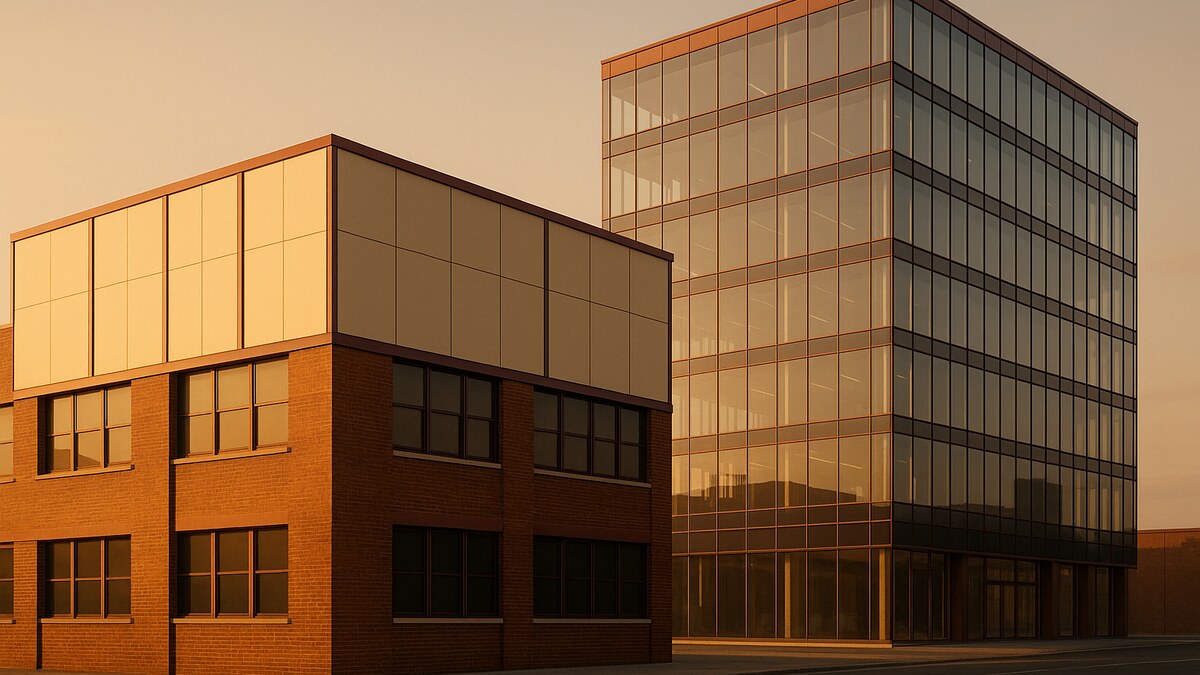
One of the first questions from a serious owner conversation is whether the compute-panel architecture is a new-construction story or a retrofit story. The honest answer is that it is both, deliberately, and that the economics look different on each side. That is not a marketing evasion. It is a design decision embedded in US provisional 64/124,031 (filed May 14, 2026), which describes a Building-Integrated Modular Compute Surface System with mechanical and thermal interfaces suitable for either deployment path.
Retrofit: overlay on the existing envelope
For an existing building, the ROSE architecture attaches as an overlay onto conventional roof and façade surfaces. The compute panels sit above the existing waterproofing, insulation, and structural deck (on the roof side) or above the existing rainscreen and cladding (on the façade side). Attachment is engineered per site against the existing structural loading. Coolant options include air, water-glycol, refrigerant, single-phase dielectric, and two-phase dielectric, and the specific loop is selected against the existing mechanical infrastructure of the building.
The typical retrofit deployment sequence is:
- Structural survey and load analysis of the target envelope surfaces.
- Mechanical and electrical assessment against the building's existing service, with focus on how much of the existing utility interconnection is available at panel-level load.
- Attachment design and coolant-loop routing.
- Panel install, cassette commissioning, and cutover of the target workloads.
The commercial story on retrofit is that the building owner is monetizing envelope surface area that was previously producing no revenue, without displacing any interior tenants, and typically without a construction permit path that requires envelope teardown. The speed advantage is measured in months, not years.
"The retrofit case is the fastest path from a signed compute-tenancy contract to a running workload. The new-build case is the cheapest per unit of installed compute over the life of the building."
New-build: integrate at design development
For a new-construction project, the ROSE architecture integrates at the design-development phase, before the envelope details lock. Panels become a specified envelope system rather than an overlay. Attachment details are engineered as part of the primary structural and cladding drawings. Coolant routing is coordinated with the base building's mechanical systems. Access, service, and cassette-swap workflows are designed into the building's facilities program from day one.
The advantages compound: lower per-panel installed cost (because the mechanical, structural, and electrical work happens once as part of the base building, not twice), tighter thermal and acoustic performance (because the envelope system is integrated rather than added), and a cleaner architectural finish (because the panel geometry is coordinated with the building's overall design intent).
The commercial story on new-build is that the compute-panel envelope becomes a specified building system, procured and installed under the general contractor's package, with the compute-tenancy revenue underwritten as part of the pro forma from the start. For an owner or developer contemplating a Class A or trophy asset in a market where compute demand is credible, that pro forma treatment moves the building's cap rate and its long-term operating income line simultaneously.
The comparison, at a high level
- Retrofit. Faster deployment. Zero-to-revenue in months. Site-by-site engineering. Compute revenue is upside on an existing asset.
- New-build. Lower long-term cost per installed unit. Tighter architectural finish. Compute revenue is part of the base pro forma. Slower to first dollar but larger over the life of the building.
Both paths use the same underlying architecture. Both use the same cassette interface, the same coolant options, and the same compute-tenancy contract structure. The choice between them is a function of the owner's timeline, the building's stage in its own lifecycle, and the size of the compute footprint the site can absorb.
For most of the conversations ROSE is currently in, the answer is not one or the other. The answer is that a portfolio owner will do retrofit on the existing buildings that make sense today, and integrate the panels at the design-development phase on the new-construction assets already in the pipeline. The architecture supports both. The commercial model supports both. The compute tenant, for their part, does not particularly care which path put the panels on the envelope, as long as the workload runs.
Early access is limited.
ROSE is opening a small cohort for building owners with meaningful flat-roof footprint, energy tenants ready to commit to on-site load, and aligned early-stage investors. If you're one of these, we want to talk.
For information on becoming an early investor or tenant commitment, reach out to us at hello@rosepanel.io.
hello@rosepanel.io